Motivation is a terrible training partner. It shows up fired up for two weeks, then disappears without warning. If you've ever started a workout program with total enthusiasm only to crash a month later, the problem wasn't your discipline — it was your reliance on a feeling you can't control. Learning how to stay consistent with exercise is not about becoming more motivated. It's about building a system that works even when motivation is nowhere to be found.
I'm Corey Nelson, and for 12 years I coached everyday adults at a big-box gym in Omaha, Nebraska. I've watched thousands of people try to out-willpower their way through fitness. The ones who stayed consistent weren't the most excited or the most disciplined. They were the ones who stopped negotiating with themselves and started treating exercise like brushing their teeth — something you do because it's on the schedule, not because you feel like it.
Why Motivation Fades — and That's Normal
Motivation is an emotion, and emotions are temporary. You feel it intensely at the start because novelty triggers your brain's reward system. But novelty wears off. When it does, your brain looks for reasons to skip. You're tired. You're busy. You'll do it tomorrow. None of those reasons are real obstacles — they're just your brain choosing the path of least resistance.
The mistake is thinking you need to feel motivated to work out. You don't. You need a habit, and a habit doesn't ask how you feel. It just triggers the behavior. That's why a simple workout consistency strategy beats a complicated workout plan every time.
The Streak Myth
Fitness apps love streaks. They show you a flame emoji and tell you not to break the chain. But streaks turn one missed day into a catastrophe. You miss a day and the streak dies, so you feel like the whole thing is ruined. I've seen people quit entirely because they broke a 30-day streak and couldn't handle the "failure."
Here's a healthier way to think about it: aim for "most days," not "every day." If you work out four days out of seven, you're consistent. If you miss a day and come back the next, you're still consistent. Consistency is a pattern, not a perfect record.
Five Ways to Stay Consistent Without Relying on Motivation
These are the strategies I used with clients who had tried and failed multiple times. They work because they remove decisions, reduce friction, and shrink the size of "success" until it's impossible to miss.
1. Shrink the Commitment
The biggest reason people stop working out is that they set a bar they can't clear on a bad day. If your routine requires 45 minutes of effort, a busy Tuesday is going to beat it. But if your minimum is two minutes of movement, you can do that on your worst day.
Make your baseline ridiculous. Two minutes of marching. Five bodyweight squats. A walk to the mailbox. That's a win. The point is not to get fit from two minutes; the point is to keep the habit alive so you can build on it. Consistency is built on small wins, not heroic efforts.
2. Anchor It to Something You Already Do
A workout that floats in your day will get pushed aside. An anchored workout survives. Pick an existing daily habit and attach your movement to it.
Examples that work for my clients:
After you pour your morning coffee, do 10 sit-to-stands while it brews.
Before you shower, do 10 wall push-ups.
After you brush your teeth at night, do 5 minutes of stretching.
During a TV show you already watch, stand up and march during every commercial break.
You're not adding a new habit; you're piggybacking on one that already exists. The anchor does the remembering for you.
3. Prepare the Night Before
Decision fatigue kills consistency. If you wake up and have to decide what to wear, what workout to do, and where to do it, you've already spent mental energy before you've moved a muscle.
Put your workout clothes next to the bed. Fill your water bottle. Know exactly what you're going to do — not a menu of options, but a single plan. The fewer decisions between you and the workout, the more likely you are to start.
I do this every night. My shorts and t-shirt go on a chair by the bed. My phone alarm sits across the room. When I wake up, there's nothing to decide. I just stand up and start.

4. Track the Showing Up, Not the Results
Most people track the wrong thing. They track weight, reps, miles, calories. Those numbers move slowly, and when they stall, people quit. Instead, track whether you showed up.
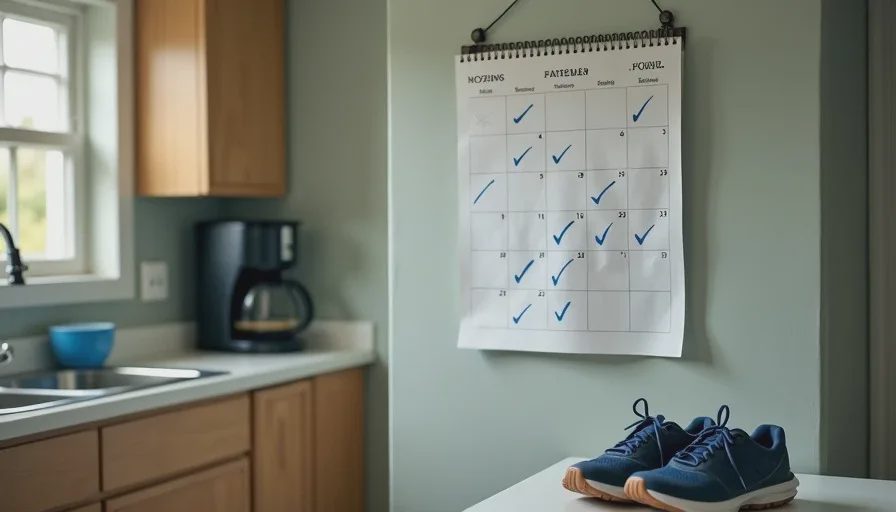
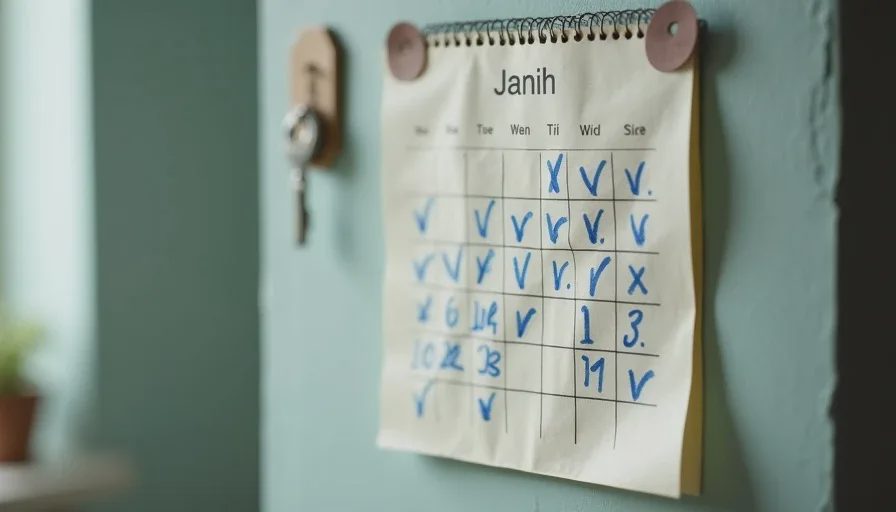
Put a check mark on a paper calendar every day you move for at least two minutes. That's it. The check mark is your metric. After a month, you'll have a chain of evidence that you are someone who works out. That identity matters more than any rep count.
When I first started my livestream community, I had one metric: did I go live? Some nights only three people showed up. Some nights my kids were crying in the background. But I kept the check marks coming. The community grew because I showed up consistently — not because I was perfect.
5. Never Miss Twice
I've said this before, and I'll keep saying it because it's the single most useful rule I know. Missing one day is a rest. Missing two days is a pattern trying to form. Your job is to break the pattern before it starts.
If you miss Monday, do two minutes on Tuesday. It doesn't matter how tired you are. It's two minutes. The act of showing up after a miss is more important than any workout you'll ever do. It tells your brain that skipping doesn't reset the system — it's just a pause.
What Consistency Actually Looks Like
It doesn't look like an Instagram feed. It looks like a working mom doing bodyweight squats in her kitchen at 6:45 in the morning. It looks like a 50-year-old guy holding a plank during a commercial break. It looks like someone who missed three days because life happened and then quietly did a 10-minute floor workout on the fourth day.
One of my clients, a dad of two named Kevin, told me he'd failed at "consistency" for 20 years. The problem was that his definition of consistency was doing a five-day gym split for months at a time. When we changed his definition to "move for at least two minutes, four days a week," he stopped failing. Two years later, he still checks the box. Some weeks he does five real workouts. Some weeks he does four short ones. But he's never "off the wagon" because the wagon is small enough to stay on.
Show Up. Sweat a Little. Come Back.
You don't need to be motivated to be consistent. You need a small plan, a few anchors, and a way to win on your worst days. If you can do that, you'll build the one thing that matters more than any workout program: the habit of coming back.
So tonight, before bed, put your shoes by the door and set out your clothes. Tomorrow, when you pour your coffee, do 10 sit-to-stands. Then put a check mark on the calendar. That's it. That's how consistency starts. Not with a bang, but with a check mark.




No comments yet — be the first to share a thought.