
The other morning, I watched my wife Beth hoist our two-year-old Theo onto her hip with one arm while carrying a laundry basket in the other. She didn't brace herself or shift her weight or pause to think about it. She just lifted, carried, and moved. That's functional strength — the kind that shows up in your real life, not in a gym mirror. And it's the kind of strength I care about far more than how much weight you can load on a bar. This post is about getting strong enough to carry your kid, your groceries, and your day without falling apart by the time you hit the couch.
I'm Corey Nelson. For 12 years, I worked as a trainer and fitness director at a big-box gym in Omaha, Nebraska, coaching thousands of everyday adults. The ones who stuck with strength training weren't the ones chasing a bigger squat. They were the ones who noticed that carrying their grandkid up the stairs felt easier, or that their lower back stopped twinging after a long day of errands. That's real-life strength. And it's trainable — with simple moves you can do at home, no equipment required.
Why "Gym Strength" Doesn't Always Transfer
The fitness industry has spent decades convincing us that strength means barbells, dumbbells, and machines. There's nothing wrong with those tools, but they don't automatically make you useful. You can leg press 300 pounds and still struggle to pick up a toddler from the floor. You can bench press a lot and still feel your shoulders burn after carrying groceries for ten minutes. That's because gym strength and real-life strength are two different things.
Gym strength trains your muscles in a controlled, predictable environment. Real life is unpredictable. It's a kid who squirms, a grocery bag that shifts, a car seat that sits at an awkward angle. Functional strength trains your body to handle movement patterns — squats, hinges, carries, rotations, pushes, pulls — not isolated muscles. When you train the pattern, your body learns to move as a unit, which is exactly what real life demands.
The Myth of "Bulky"
I want to address this because it stops too many people — especially women — from strength training. Lifting heavy stuff will not make you bulky. It will make you capable. The "bulky" look comes from years of hyper-specific training, often paired with a calorie surplus and a specific genetic profile. For the average busy adult, strength training simply builds the muscle you need to function. You'll look like yourself, just a little more solid.
Five Moves for Real-Life Strength
These five exercises train the movements you use every day: squatting, hinging, carrying, pushing, and rotating. Do them two or three times a week. You can do them as a circuit with 45 seconds of work and 15 seconds of rest, or as straight sets of 8–12 reps. All you need is a floor, a wall, and something to carry — like a backpack, a loaded grocery bag, or a small child if they're willing.
1. Sit-to-Stand (The Kid Pickup)
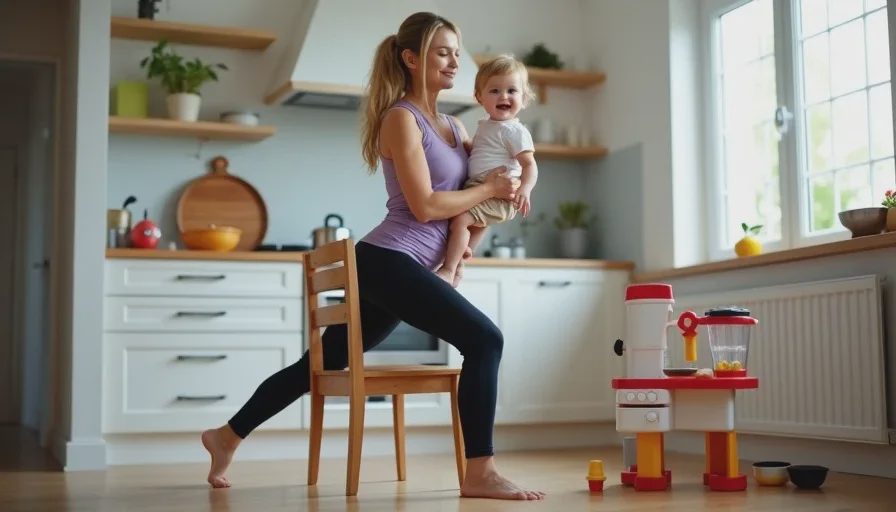
This is the most underrated exercise for parents. Every time you stand up from a chair while holding a kid or a pile of laundry, you're doing a sit-to-stand. Practicing it without weight teaches your hips and legs to work together.
Find a sturdy chair or bench. Sit down, keep your feet flat on the floor, and stand up without using your hands. Push through your heels and squeeze your glutes at the top. Lower back down slowly. Do 10–12 reps. Once that's easy, hold a backpack filled with books or a bag of rice against your chest.
2. Farmer Carry (The Grocery Haul)
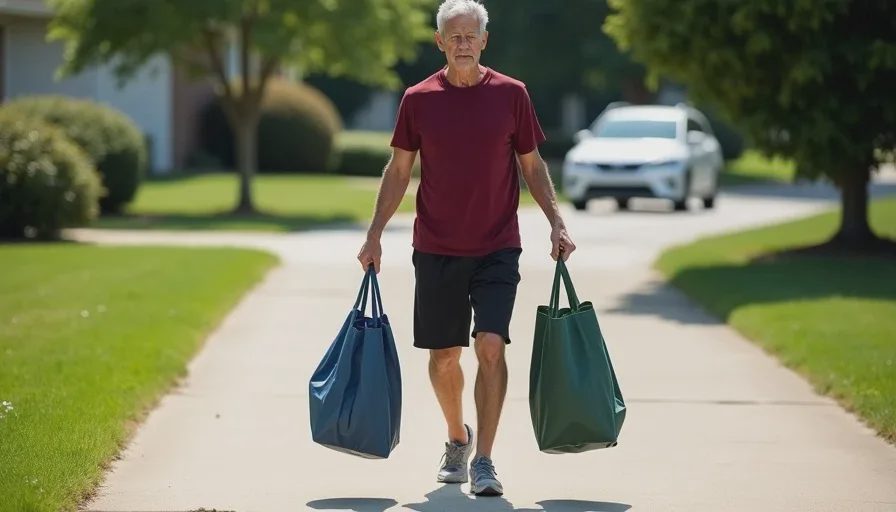
This is the single best exercise for translating strength to daily life. Pick up something heavy in each hand — a grocery bag with a few cans, a couple of water bottles, a backpack in each hand — and walk. Keep your shoulders down, your core braced, and your steps steady.
Walk for 30–45 seconds, then rest. Do three rounds. This trains your grip, your core, and your ability to stay upright under load. It's the exact movement you use when you carry groceries from the car to the kitchen, except now you're practicing it on purpose.
3. Wall Push-Up (The "Get Off the Floor" Strength)
When you push yourself up from the floor or a low couch, you're doing a push-up. Wall push-ups train that same pattern with less stress on your wrists and shoulders. Stand facing a wall, place your hands at shoulder height, and lower your chest toward the wall, then push back. Keep your body in a straight line.
Do 10–15 reps. If that's easy, move your hands to a kitchen counter or a sturdy table to increase the angle. Eventually you can work toward floor push-ups from your knees.
4. Suitcase Deadlift (The Laundry Basket Lift)
This trains the hinge pattern — the movement you use when you bend to pick something up without rounding your back. Stand with a heavy object (a laundry basket, a backpack, a bag of dog food) on the floor in front of you. Push your hips back, soften your knees, and hinge forward to grab it. Keep your back flat. Drive through your heels to stand up, keeping the object close to your body.
Do 8–12 reps. The key is not the weight — it's the pattern. Your back should stay neutral the whole time. If you feel your lower back rounding, lower the weight.
5. Dead Bug (The Core Stabilizer)
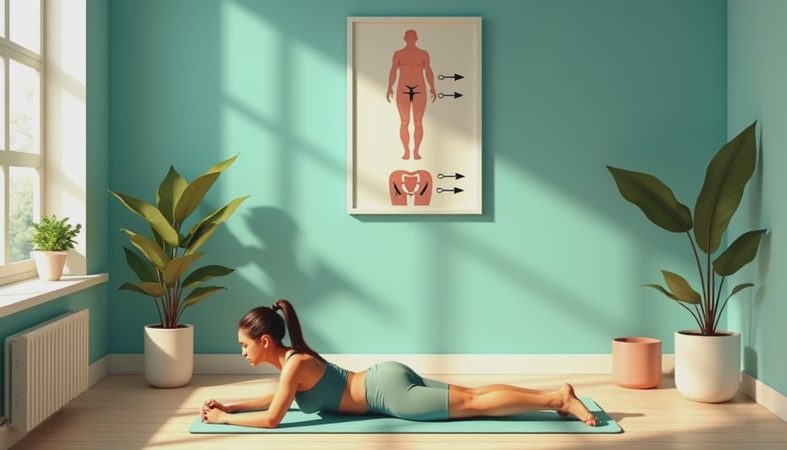
Your core's job is not to do crunches; it's to keep your spine stable while your arms and legs move. The dead bug trains that skill. Lie on your back with your arms pointing up and your knees bent at 90 degrees. Slowly lower one arm and the opposite leg toward the floor, then return. Alternate sides.
Do 10 reps per side, moving slowly. This builds the kind of core strength that protects your lower back when you twist to grab a kid from a car seat or reach into the back of the fridge.
How This Shows Up in Real Life
Let me give you a picture. One of my clients, a 44-year-old dad named Rob, came to me after throwing out his back lifting his four-year-old into a shopping cart. He was embarrassed, frustrated, and a little scared. He thought he needed to avoid lifting altogether. Instead, we spent six weeks doing sit-to-stands, farmer carries, and dead bugs. He didn't touch a barbell once.
A month later, Rob told me he'd carried his daughter up two flights of stairs without thinking about it. His back was fine. The strength didn't come from one heroic session — it came from consistently training the movements his life actually required.
You Don't Need to Be an Athlete to Be Useful
The goal of real-life strength isn't to impress anyone. It's to be the person who can carry their own groceries, lift their own kids, and move their own furniture when needed. It's to stay independent and capable as you age. You don't need a gym membership or a complicated program. You need a few simple moves, done consistently, that make daily life feel easier.
So the next time you pick up a heavy bag of groceries or swing your kid onto your hip, notice it. That's your strength in action. And if it feels harder than it should, that's not a sign of failure — it's a sign to start training. Show up. Sweat a little. Come back. And get strong enough for the life you actually live.
No comments yet — be the first to share a thought.