
When my daughter Harper was an infant, I used to lie in bed at 5:45 a.m. and negotiate with myself. If I get up now, I can get 15 minutes before she cries. If I sleep, I'll feel guilty all day. Some mornings I got up. Some mornings I didn't. The difference between the days I did and the days I didn't was never about motivation — it was about having a plan so simple that my half-awake brain could follow it without thinking. That's what this 15-minute workout is: a quiet, no-equipment routine that fits before the kids wake up, even if you're running on five hours of sleep.
I'm Corey Nelson. For 12 years I coached busy parents at a big-box gym in Omaha, and now I run my own livestream workout community from my living room. I know what it's like to want to exercise while your household is still asleep. You don't need an hour. You don't need a gym. You need 15 minutes, a patch of floor, and a routine that doesn't sound like you're moving furniture.
Why 15 Minutes Is Enough
The most common thing I heard from busy parents was, "I don't have time to work out." What they usually meant was, "I don't have time for an hour-long workout plus a shower plus a commute." That's true. But you do have 15 minutes if you're willing to trade 15 minutes of sleep or 15 minutes of scrolling. And here's the part that surprises people: a consistent 15-minute workout done four or five days a week does more for your health than a two-hour gym session you only manage once a month.
The key is to stop treating exercise as an all-or-nothing event. A short beginner workout with no equipment can raise your heart rate, wake up your muscles, and build the habit — all before your kids finish their first bowl of cereal. You don't need to be drenched in sweat to earn the day.
The Quiet 15-Minute Routine
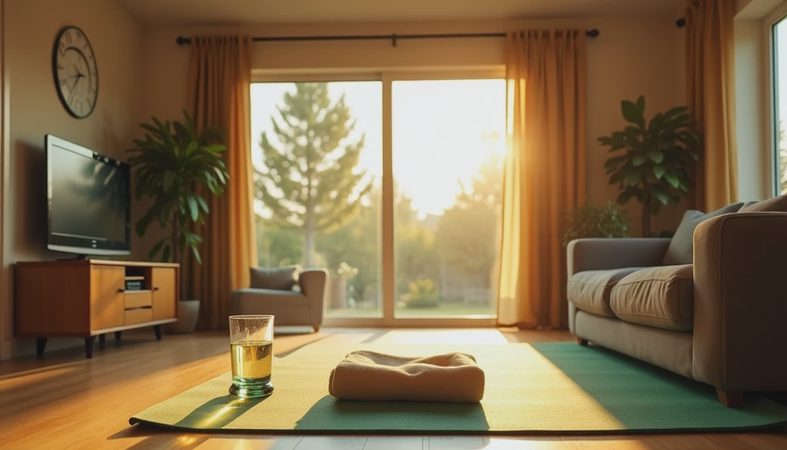
This routine is designed to be silent enough for a sleeping house. No jumping, no dropping weights, no loud breathing. You can do it barefoot on a yoga mat or a rug. All you need is a timer, some water, and enough space to lie down and stand up.
Warm-Up (2 Minutes)
Start with two minutes of gentle movement to wake your joints. March in place slowly, rolling your shoulders and reaching your arms overhead. If you're stiff from sleep, do a few neck rolls and ankle circles. The goal is to signal to your body that movement is safe, not to spike your heart rate.
Strength Circuit (10 Minutes)
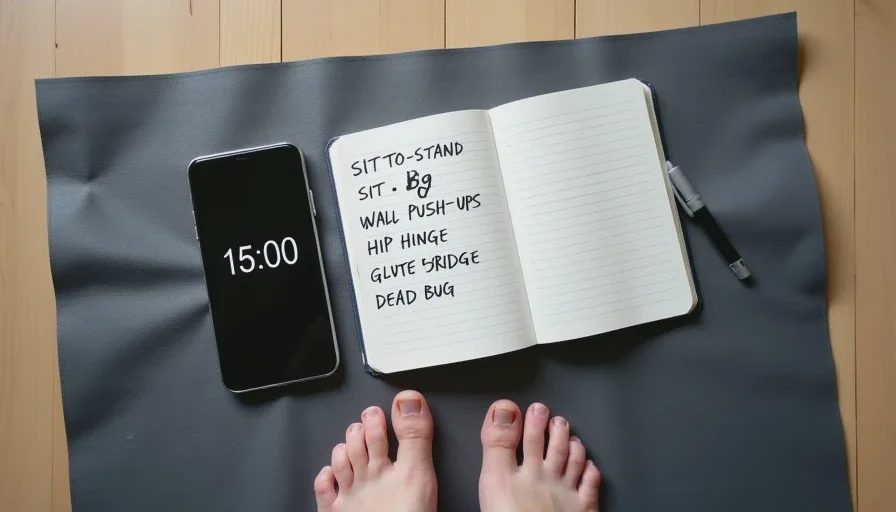
Set a timer for 10 minutes and move through the following five exercises in order. Do each one for 45 seconds, then rest for 15 seconds before moving to the next. After finishing all five, take a one-minute rest, then repeat the circuit once if you have time.
Sit-to-Stand from a Chair or Coffee Table — Find a sturdy surface. Sit down, then stand up without using your hands. This works your legs and glutes, and it's quiet. If you need support, tap the surface lightly with your fingertips.
Wall Push-Ups — Place your hands on a wall at shoulder height and perform 10–15 slow push-ups. This strengthens your chest and arms without any floor noise. If you're stronger, use a kitchen counter instead.
Standing Hip Hinge — Stand with your feet hip-width apart, push your hips back like you're closing a car door with your butt, and return to standing. This wakes up your hamstrings and lower back. Keep your knees soft.
Glute Bridge on the Floor — Lie on your back with your knees bent and feet flat. Lift your hips until your body forms a straight line from knees to shoulders, then lower slowly. Do this on a mat to keep it silent.
Dead Bug — Lie on your back with your arms pointing up and your knees bent at 90 degrees. Lower one arm and the opposite leg toward the floor, then return. Alternate sides. This builds core strength without crunches.
That's it. No jumping jacks, no mountain climbers, no noise. You'll feel warm and a little more awake, but you won't wake the kids.
Cool-Down (3 Minutes)
Finish with three minutes of slow stretching. Touch your toes, stretch your hips with a kneeling lunge, and take a few deep breaths. This is also a good moment to listen for small footsteps — if a kid appears, you're already done or almost done.
Tips for Making It Stick
The hardest part of a morning workout is not the exercises; it's getting out of bed. Here are a few things that helped me and my clients.
Put Your Clothes Out the Night Before
I leave a pair of shorts and a t-shirt next to the bed before I go to sleep. When my alarm goes off, I don't have to make decisions. I just put them on. Decision fatigue is real, and 5:45 a.m. is not the time to fight it.
Keep Your Phone Across the Room
My alarm lives on a shelf across the bedroom, not on the nightstand. That forces me to stand up to turn it off. Once I'm standing, I'm already halfway to the living room. It's a tiny trick that works.
Accept That Some Days Will Be Interrupted
Harper is five now, and Theo is two. Some mornings, one of them wakes up early and climbs onto my mat. That's not a failed workout; it's a family moment. I'll let them "do" a wall push-up with me or just sit on my stomach during the glute bridge. The workout might get cut short, but the habit stays alive.
What If You're Not a Morning Person?
You don't have to do this at 6 a.m. You can do it during nap time, after bedtime, or on your lunch break. The point is not the hour; it's the consistency. A 15-minute workout that fits before the kids wake up just happens to be a reliable window for many parents. If your window is different, use that.
One of my clients, a mom of three boys, did this exact routine after her kids went to school. She told me it was the first time in years she'd exercised without feeling guilty about taking time away from them. That's the whole idea: find a small pocket of time that's yours, and protect it like it matters — because it does.

Show Up. Sweat a Little. Come Back.
You don't need to be a fitness person to do this. You don't need to post about it or track it in an app. You just need to wake up 15 minutes earlier, move your body in a way that feels good, and do it again tomorrow. The first week will be hard. The second week will be easier. By the third week, you'll notice the difference — not in a mirror, but in the way you carry your coffee and chase your kid up the stairs.
That's real progress. That's what showing up looks like.


No comments yet — be the first to share a thought.