
If you're here because you quit again, let me say this before anything else: starting over is not failure. It's the most normal part of building a fitness habit. I've coached enough people to know that almost nobody gets it right the first time. The problem isn't that you stopped — it's that someone convinced you that stopping means you lost. You didn't. This post is about how to start over after quitting the gym without dragging guilt and shame back onto the mat with you.
I'm Corey Nelson. For 12 years, I worked at a big-box gym in Omaha, Nebraska. I saw the same cycle every January: people signed up, showed up for a few weeks, then disappeared. Some came back in March with their heads down, apologizing like they'd let me down. They hadn't. Quitting was never the problem. The problem was the story they told themselves when they restarted — that they were back at zero, that all their past effort was wasted, that they had to "make up" for lost time. That story is what made restarting feel impossible.
Why Restarting Feels So Heavy
The fitness industry loves the "streak" mindset. It tells you that missing a day breaks the chain and that a broken chain means you're not disciplined. But life doesn't work that way. Kids get sick. Work explodes. Your back goes out. You go on vacation. You get tired. A streak is a useful tool until it becomes a weapon you use against yourself.
When you restart after a break, your brain does something unhelpful: it compares your current self to the self who was working out consistently. You remember the strength you had, the energy, the routine — and then you look at the floor and feel like a stranger. That comparison makes the first step feel heavier than it actually is.
I worked with a client named Marcus, a 39-year-old teacher who had been consistent for eight months, then stopped for six weeks after a family emergency. When he came back, he tried to jump straight into his old workout. He got through half of it, felt awful, and told me he'd "lost everything." That wasn't true. His body remembered more than he gave it credit for. But his brain was stuck in the all-or-nothing trap.
Stop the "Clean Slate" Trap
The first thing to do when you restart is to reject the idea that you're starting from zero. You're not. Even if you took a year off, your body has muscle memory, your joints remember how to move, and your brain still knows the habit exists. Starting over doesn't erase the fact that you did it before. It just means you're doing it again.
Don't Try to Make Up Lost Time
This is the biggest mistake restarters make. They think they need to do double workouts, extend sessions, or punish themselves with harder exercises to "catch up." That leads to soreness, burnout, and quitting again. The past is gone. You don't owe it anything. Your only job is to show up today and do something reasonable.
Lower the Bar on Purpose
When you restart, set the bar lower than you think you need. If you used to do 30-minute workouts, start with 10. If you used to do three sets, do one. The goal of the first two weeks is not fitness — it's rebuilding the habit of showing up. Your body will catch up faster than you expect, but only if you give it time.
A Simple Three-Step Restart Plan
Here's how I help clients ease back in after a break. It's designed to feel almost too easy, and that's the point.
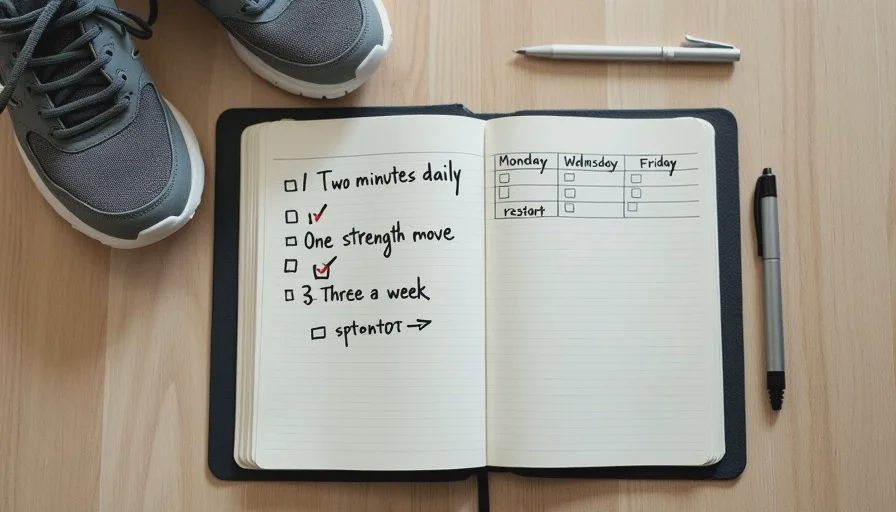
Step 1: Commit to the Two-Minute Version
For the first week, don't plan a workout. Plan a ritual. Every day at the same time, put on your workout clothes and do two minutes of movement — marching in place, stretching, walking around the block. That's it. This reconnects the cue (time of day) with the action (moving) without triggering dread. If you do more, great. If not, you still showed up.
Step 2: Add One Small Strength Move
In the second week, add one bodyweight exercise to your two minutes. Try 10 sit-to-stands from a chair or 10 wall push-ups. Do this every day, but keep the total time under 10 minutes. The goal is to remind your muscles and your brain that strength work is safe and doable.
Step 3: Rebuild to Three Days a Week
In the third week, move to a simple three-day routine. Pick a day for legs, a day for upper body, and a day for a full-body mix. Use the no-equipment moves from my other posts — glute bridges, hip hinges, wall push-ups, dead bugs. Keep each session to 15–20 minutes. Don't add intensity until you've done this for two full weeks without missing a day.
What to Do When You Feel Like You've "Lost Everything"
That feeling is real, but it's not truth. Here are three reminders I give clients who are restarting.
Strength Comes Back Faster Than You Think
Muscle memory is a genuine physiological thing. Your nervous system has already learned the movement patterns. When you restart, your body reconnects those pathways much faster than it took to build them the first time. You're not rebuilding from scratch; you're refreshing what's already there.
You Didn't Lose the Habit, Just the Momentum
A habit is a pathway in your brain. Even if you stopped using it, the pathway still exists. Restarting is like walking down an overgrown trail instead of hacking through a jungle. The first few steps might feel clumsy, but the trail is still there underneath.
Quitting Once Doesn't Mean You'll Quit Forever
I've restarted my own routine more times than I can count. When my son Theo was born, I barely worked out for two months. I didn't call it failure; I called it being a dad. Then I started again with a 10-minute walk and some bodyweight squats. The restart was quiet, and that's okay.

Show Up. Sweat a Little. Come Back.
If you've quit, you're in good company. Every person who has ever built a lasting fitness habit has quit at least once. The difference between those who get back on track and those who don't isn't willpower — it's the ability to restart without self-punishment.
So here's your first step back: put on your shoes and walk for two minutes. That's not a workout. It's a reminder. Tomorrow, do it again. Starting over is not failure. It's just the next rep.




No comments yet — be the first to share a thought.