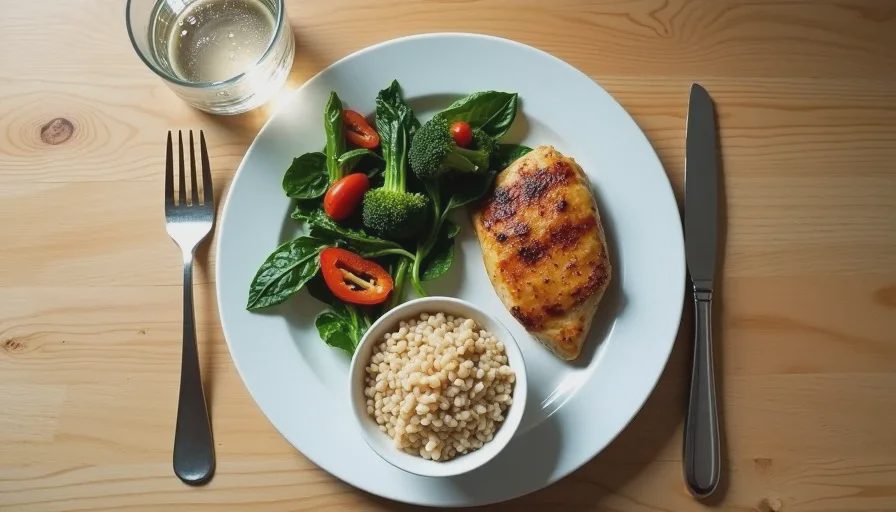
Let me tell you about the year Beth and I tried to "eat clean." It was before Harper was born, and we had just joined a gym where I worked. Beth, my wife, decided we were going to follow a popular 30-day program that promised to "reset" our metabolism. We threw out everything white — bread, pasta, sugar — and stocked the fridge with kale, chicken, and the kind of sadness that comes from eating unseasoned broccoli. We lasted 19 days. On day 20, Beth ate half a loaf of sourdough over the sink and said, "I don't care if this is clean, it's delicious." That was the day I stopped recommending diets and started teaching something simpler: you don't need a diet. You need a plate that works.
I'm Corey Nelson, and I've spent 12 years coaching everyday adults in Omaha, Nebraska. Most of them came to me with the same story: they'd tried every diet out there, lost some weight, gained it back, and felt like failures. The problem was never their willpower. The problem was that diets are designed to be temporary. A plate that works, on the other hand, is just how you eat — forever.
Why Diets Fail Before Lunch
Diets almost always fail for one simple reason: they're built on restriction. Cut this, avoid that, eat only these foods at these times, and if you slip up, you've blown it. That kind of thinking turns every meal into a test, and tests are exhausting. You can pass a test for a few weeks, but you can't pass it every day for the rest of your life.
The other problem is that diets make food the enemy. You start to believe that carbohydrates are bad, fat is dangerous, and hunger is something to be ignored. That's not just unsustainable — it's miserable. Food is not a moral challenge. It's fuel, it's pleasure, it's family, it's culture. When a diet asks you to cut those things out, it's asking you to cut out a part of your life.
I watched this play out with hundreds of gym members. They'd come in January with a list of banned foods and a calorie target. By March, they'd be in my office, apologizing for eating a piece of cake at a birthday party. I'd tell them the same thing every time: one piece of cake doesn't ruin anything. What ruins progress is the guilt spiral that makes you say, "Well, I already blew it, so I might as well eat the whole cake." Diets create that spiral by making food all-or-nothing. A plate that works doesn't have an "all" or a "nothing." It just has a shape.
The Plate Method: Simple, Flexible, Done
The plate method is not my invention. It's been used by nutritionists for years, and I started teaching it because it's the only approach that survived contact with real life. Here's how it works.
Step 1: Look at Your Plate
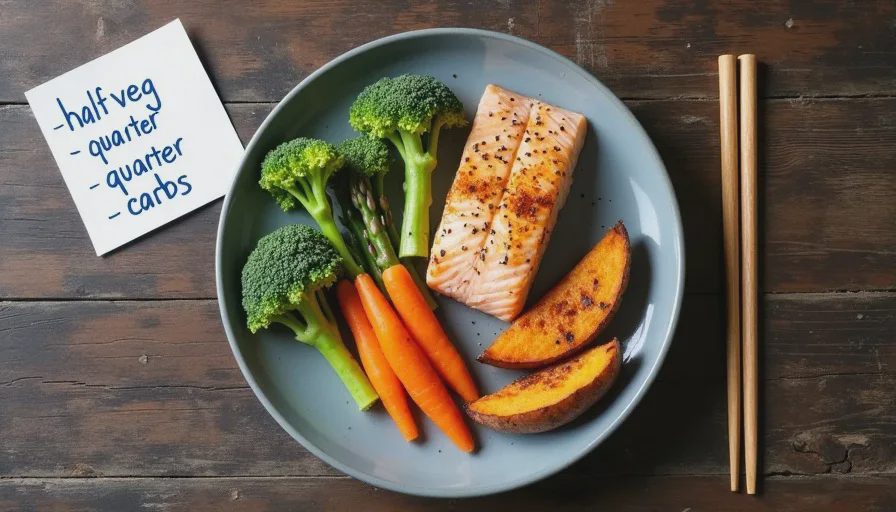
Imagine a standard dinner plate divided into three sections. Half of the plate is vegetables or fruit. One quarter is protein. One quarter is carbohydrates. That's it. That's the whole framework.
You don't need to measure anything. You don't need to weigh your food. You just look at your plate and ask: Is half of this vegetables? Is there a protein? Is there a carb? If the answer is yes, you're done. If not, adjust.
Step 2: Build the Plate
Here's what a plate might look like on a random Tuesday:
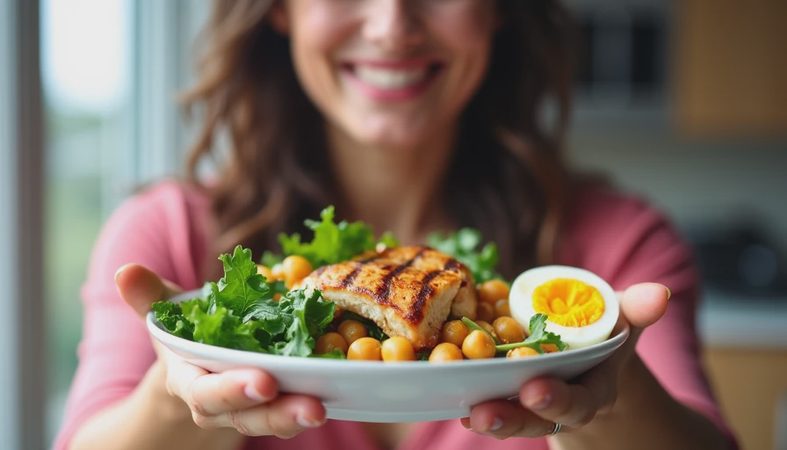
Half vegetables: roasted broccoli, a handful of spinach, some sliced cucumbers, whatever you have. Frozen vegetables count. Canned vegetables count. This is not a farmers market competition.
One quarter protein: a chicken thigh, a salmon fillet, a scoop of lentils, a couple of eggs, or a block of tofu. Size doesn't need to be exact. Roughly the palm of your hand.
One quarter carbohydrates: rice, pasta, potatoes, a slice of bread, a tortilla, even a pancake if that's what you're eating. Carbs are not the enemy. They're fuel.
That's a full meal. It has protein for muscle repair, carbs for energy, vegetables for fiber and micronutrients, and it probably includes some fat from cooking oil, dressing, or the protein itself. You don't need to track any of it.
Step 3: Eat Until You're Satisfied, Not Stuffed
The plate method gives you a structure, but it doesn't dictate portions beyond the visual. Your body knows when it's full. The problem is that diets teach you to ignore those signals — eat exactly this amount, no more, no less. That's a recipe for overthinking. Instead, eat your plate slowly, notice when you're satisfied, and stop. If you're still hungry, add more vegetables or a little more protein. If you're too full, next time put less on the plate. That's called feedback, not failure.
What About Snacks, Dessert, and Eating Out?
The plate method doesn't ban anything. It just gives you a default. Snacks are fine. Dessert is fine. Eating out is fine. You don't have to build a perfect plate at every single meal. The goal is to make the plate your baseline, not your prison.
Snacks
If you're hungry between meals, eat something. The plate method doesn't say "no snacks." It just suggests you think about what you're missing. If your lunch was light on protein, grab a handful of nuts or a yogurt. If you didn't get many vegetables, eat some baby carrots with hummus. If you want a cookie, have a cookie. One cookie is not a dietary collapse.
Dessert
You don't need to earn dessert with a workout, and you don't need to feel guilty for having it. Dessert is part of life. The plate method just means that your main meals have a balanced structure, so a little something sweet afterward doesn't throw anything off. I had a client who used to eat a bowl of ice cream every night and feel terrible about it. We didn't take away the ice cream. We just made sure her dinners had enough protein and vegetables. She still eats ice cream. She just doesn't cry about it anymore.
Eating Out
Restaurants are not traps. Use the same mental model: does this meal have vegetables? Protein? Carbs? If the menu has a grilled chicken sandwich with a side salad, that's a plate. If you want the burger, get the burger and add a side of vegetables. If you want fries, get fries — maybe split them or get a small. This isn't about purity. It's about awareness.
Why I Stopped Saying "Diet" and Started Saying "Plate"
Words matter. When I used to say "diet," my clients heard "temporary suffering." When I said "plate," they heard "this is just how I eat." That shift changed everything.
One of my clients, a 51-year-old nurse named Maria, had been dieting off and on for 30 years. She'd tried Weight Watchers, keto, paleo, juice cleanses — you name it. When she came to me, she said she didn't want another program. She wanted to eat like a normal person. So we used the plate method. We didn't cut anything. We didn't count anything. We just looked at her meals and made sure each one had the three parts. Three months later, she told me she'd stopped thinking about food for the first time in decades. She'd lost some weight, yes, but more importantly, she'd stopped being afraid of dinner.
That's the goal. Not perfection, not control, but peace. You don't need a diet to get that. You need a plate that works — one that's half vegetables, a quarter protein, a quarter carbs, and a whole lot of flexibility.

Show Up. Eat a Little. Move On.
If you've been caught in the diet cycle, I want you to take a deep breath. You haven't failed. You've been given bad tools. A plate is a better tool. It's simple, it's forgiving, and it works for busy people who don't have time to obsess over every bite.
Tonight at dinner, try it. Fill half your plate with vegetables, a quarter with protein, a quarter with carbs. Eat it. Enjoy it. Then go about your evening. That's not a diet. That's just eating. And it's enough.


No comments yet — be the first to share a thought.