
The phrase "functional fitness" sounds like something a marketing team invented to sell kettlebells and fancy gym memberships. And to be fair, plenty of people have used it that way. But strip away the branding, and you're left with something very old and very simple: training your body to be useful in the life you actually live. Functional fitness isn't a fad. It's just being useful. That's the whole idea, and it's been around since the first human had to carry firewood, lift a child, and run from bad weather.
I'm Corey Nelson, and I've spent 12 years coaching everyday adults at a big-box gym in Omaha, Nebraska, and now through my livestream community. When I first heard the term "functional fitness" years ago, I rolled my eyes. It sounded like another wave of buzzwords. But once I looked past the marketing, I realized it described exactly what I'd been teaching all along: strength that transfers to your real life. Not a trend, just a return to the basics.
What "Functional Fitness" Actually Means
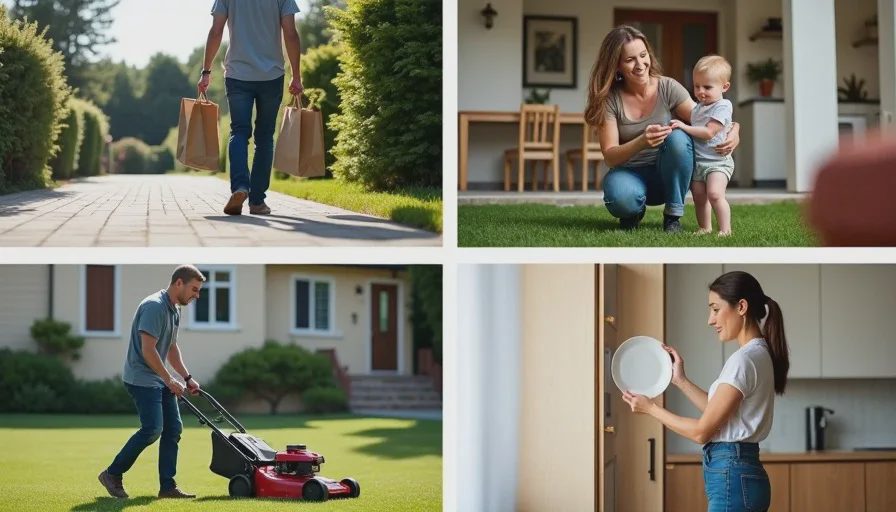
At its core, functional fitness means training movement patterns, not just isolated muscles. Instead of asking "how much can this muscle lift?" it asks "can this body squat, hinge, carry, push, pull, rotate, and walk without pain or weakness?" Those are the movements you use every single day, whether you're picking up a toddler, hauling groceries, getting off the floor, or reaching for something on a high shelf.
Most gym machines train isolated muscles in a fixed path. That's great for building size or rehabbing a specific joint, but it doesn't always prepare you for the unpredictable demands of life. Life doesn't happen on a padded seat with a cable guiding your range of motion. Life is a squirming kid, a lopsided grocery bag, a suitcase you have to hoist into an overhead bin, a patch of ice you have to brace against.
Functional training uses your body as a unit. It teaches your muscles to work together, your core to stabilize, and your joints to move through natural ranges. That's why a farmer carry with a heavy bag mimics carrying groceries, and a sit-to-stand mirrors getting up from a chair while holding a baby. You're not just building muscle; you're building competence.
The Problem with "Gym Strength"
Now, I'm not anti-gym. I worked in one for over a decade. Barbells, dumbbells, and machines are tools, and they can be used well or poorly. The problem is that many people confuse gym performance with real-world capability. I've seen plenty of guys who could leg press 400 pounds but threw out their backs picking up a box. I've seen people who could do endless bicep curls but couldn't carry their groceries up a flight of stairs without losing their breath.
That's because gym strength often lives in a controlled environment. You sit on a machine, adjust the pin, and move through a fixed path. Your core doesn't have to work as hard because the machine stabilizes you. Your balance isn't challenged because you're planted on a seat. Real life is messier. It demands strength that works when your feet are uneven, your load is shifting, and your kid is wiggling.
Functional fitness bridges that gap. It takes the strength you build and teaches your body to use it in dynamic, real-world situations.
The Real History: It's Older Than Any Trend
If you look at how humans trained before the fitness industry existed, you'll find farmers, soldiers, laborers, and athletes doing movements that look a lot like what we now call "functional." Farmers carried feed bags, lifted hay bales, and walked on uneven ground. Soldiers climbed, crawled, and hauled gear. Dancers and gymnasts moved their bodies through full ranges with control. None of them used a leg extension machine.
The modern gym machine became popular in the mid-20th century because it allowed people to train specific muscles in a safe, seated position. That had value — especially for bodybuilders and rehab patients. But somewhere along the way, we started to think that if you couldn't measure it on a machine, it didn't count. Functional fitness is a correction to that mindset. It's not new; it's a reminder that the original purpose of strength was to do things.
One of my mentors used to say, "Strength is the ability to do work." A machine can make you bigger, but it can't teach you to lift a squirming kid out of a car seat. That takes practice with a squirming kid — or at least a movement pattern that mimics it.
How Functional Fitness Shows Up in Daily Life
The best way to understand functional fitness is to look at the movements you already do. If you can train these patterns, your daily life gets easier.
The Squat Pattern
Every time you get up from a chair, sit on a low couch, or pick something up from the floor, you're using a squat pattern. Training the squat — even with just your bodyweight — strengthens your legs, hips, and core in a way that makes those daily tasks feel lighter. A sit-to-stand is a functional squat. You don't need a barbell.
The Hinge Pattern
Bending over to pick up a laundry basket, a toddler, or a bag of dog food uses a hinge pattern. If you round your back instead of hinging at the hips, you put your lower back at risk. Training the hinge with a light weight or even just your body teaches your body to move safely and efficiently. That's functional strength for your spine.
The Carry
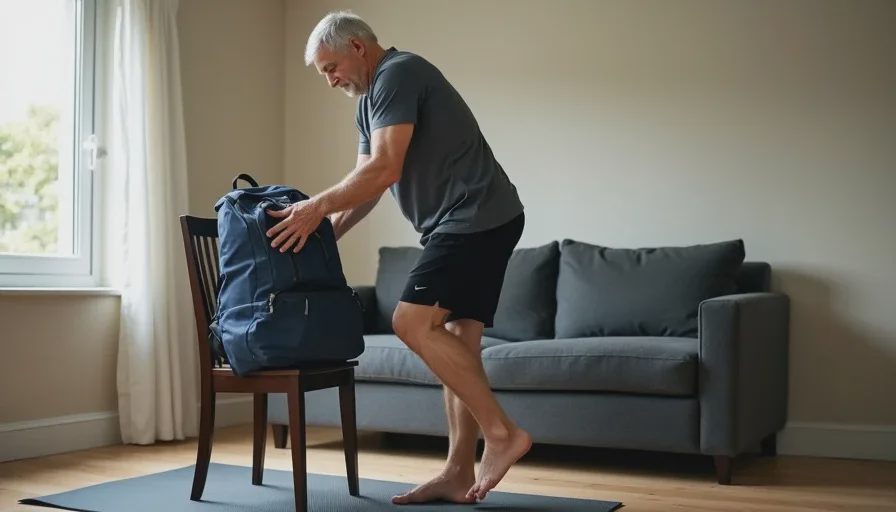
Carrying groceries, kids, suitcases, or a heavy toolbox all involve holding a load while walking. The farmer carry trains this directly. It builds grip strength, core stability, and the ability to stay upright under load. It's one of the most practical exercises you can do, and it requires nothing but something heavy to hold.
The Push and Pull
Pushing yourself up from the floor, pushing a heavy door, pulling a suitcase behind you, pulling a stubborn drawer open — these are push and pull patterns. Wall push-ups, counter push-ups, and bodyweight rows using a sturdy table or door frame all train these movements.
The Rotation
Reaching into the back seat of a car, twisting to hand something to a child, swinging a golf club, or shoveling snow all involve rotation. Training controlled rotation strengthens your core and protects your spine during everyday twisting movements.
Why Some People Dismiss Functional Fitness
Part of the reason "functional fitness" gets a bad rap is that some trainers and brands have turned it into a circus. You see people balancing on Bosu balls while juggling kettlebells and calling it "functional." That's not functional; that's performance art. Real functional training is boring. It's sit-to-stands, carries, hinges, and push-ups. It doesn't look impressive on Instagram, which is exactly why it works.
Another criticism is that functional training doesn't build muscle as effectively as traditional strength training. There's some truth to that if your goal is maximum muscle size. But for most everyday adults — busy parents, desk workers, people over 40 — maximum muscle size isn't the goal. The goal is to feel better, move better, and handle life without pain. Functional training delivers that more directly than any machine.
I'm not saying you should never use a barbell or a machine. Tools are tools. But if you have limited time and energy, training movement patterns gives you the most bang for your buck. You get stronger in a way that actually shows up outside the gym.
A Simple Functional Fitness Routine
If you want to test it out, try this three-day-a-week routine. Each session takes about 20 minutes. You need no equipment, just a chair, a wall, and something to carry.
Day 1: Lower Body and Carry
10 sit-to-stands from a chair (3 sets)
10 standing hip hinges, pushing your hips back (3 sets)
30-second farmer carry with a loaded backpack or grocery bag in each hand (3 rounds)
5 dead bugs per side (2 sets)
Day 2: Upper Body and Core
10 wall push-ups (3 sets)
10 counter push-ups, hands on a kitchen counter (3 sets)
10 bodyweight rows under a sturdy table (3 sets)
20-second side plank on each side (2 sets)
Day 3: Full Body Mix
8 reverse lunges per leg (3 sets)
8 glute bridges (3 sets)
10 wall push-ups (2 sets)
30-second farmer carry (2 rounds)
That's it. No crazy equipment, no balancing on unstable surfaces, no risk of looking like a circus act. Just movements that make you more useful.
The Real Test: Do You Feel More Useful?
Here's the simplest way to know if your training is working: ask yourself, "Has anything in my daily life gotten easier?" Maybe you noticed that carrying groceries up the stairs didn't wind you as much. Maybe you picked up your grandkid without bracing first. Maybe you sat on the floor to play with your dog and got back up without using your hands. Those are the wins that matter.
I had a client named Evelyn, a 58-year-old retiree who came to me after she struggled to lift her 30-pound dog into the car. She'd been doing machine circuits at the gym for years, but the leg press didn't help her with that awkward, wiggly lift. We spent two months on farmer carries, sit-to-stands, and hip hinges. Then one day she told me, "I lifted Moose into the car yesterday and didn't even think about it." That's functional fitness. That's being useful. And that's never going out of style.
Show Up. Move a Little. Be Useful.
Functional fitness isn't a trend to chase or a buzzword to toss around. It's a simple, timeless idea: train your body for the life you have. The next time you hear the term, don't roll your eyes like I once did. Think about the groceries, the kids, the dog, the suitcase, the million small tasks that make up your day. Then go do some sit-to-stands and carries. That's not a fad. That's just being useful.
No comments yet — be the first to share a thought.